


Abruzzo is all about breathtaking landscapes and picturesque villages rich in history and charm. But not only that, in fact, it also offersexcellent regional cuisine characterized by simple and tasty dishes. The gray and green color of the mountains fades between perched villages and ancient medieval hermitages, to the sand and rocks of the low coast of the Adriatic Sea. An area rich in history, traditions and artistic testimonies that never cease to surprise visitors. So here are the 10 must-see destinations in Abruzzo!
TORRE DEL CERRANO MARINE PARK
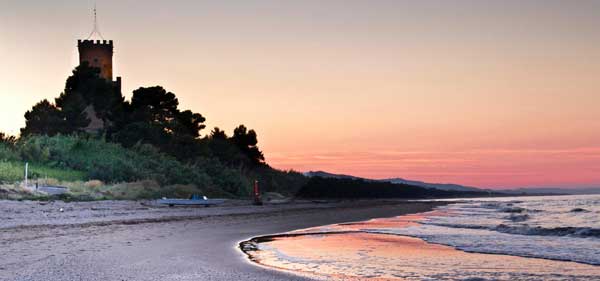
Included in the Teramo stretch between the municipalities of Pineto and Silvi, the Torre del Cerrano Marine Park is the first marine protected area in Abruzzo and the mid-Adriatic Sea. The park, which delimits 7 kilometers of coastline and extends up to 3 nautical miles, protects a unique stretch of sea in Abruzzo, because it is one of the few remaining ones where an almost intact dune environment can be found. The area’s body of water has two environmental types: typical Adriatic sandy bottoms; and some parts of bottom reefs, determined by both the semi-submerged boulders of the ancient port of the city of Hadria and the submerged structures of the provincial marine protection oasis. In addition to a good number of marine animal species, the area is also home to several species of avifauna, including the Fratino, a small endangered bird that lays its eggs here in the period from April to July. More info: Official website Torre del Cerrano Marine Park
CITY SANT’ANGELO
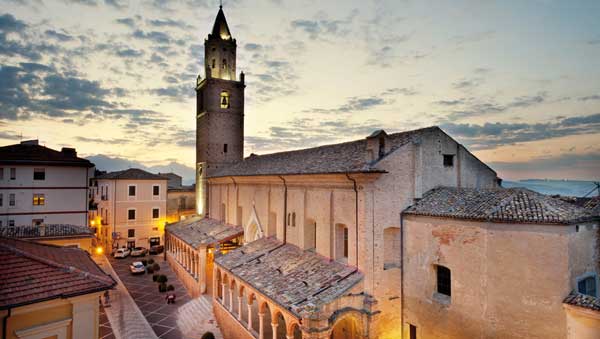
Situated on a natural belvedere of hills that sweeps from the peaks of the Gran Sasso to the sea, Città Sant’Angelo is a charming village whose origins, although uncertain and a cause for debate among historians, seem to date back to the time of the Vestini. The village is famous for the production of wine and extra virgin olive oil of extraordinary quality, which is why Città Sant’Angelo is recognized as an “Oil City,” “Wine City” and “Cittaslow.” Of particular interest is its historic center of medieval layout with taverns and inns that evoke stories of soldiers and village life. The mighty mass of the Collegiate Church, the many beautiful churches, the noble palaces and the historic city gates give the town a proud and dynamic appearance, where the artistic and cultural dimension blends perfectly with the historical one.
RAVINES OF ATRI
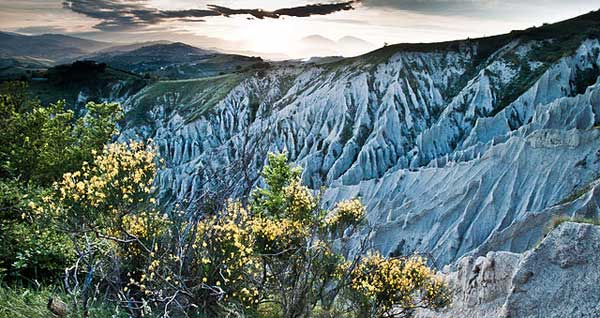
The Calanchi di Atri Nature Reserve, a Site of Community Interest and WWF Oasis, covers about 380 hectares and features one of the most fascinating forms of the Adriatic hilly landscape, the extraordinary geological formations of the Calanchi, also known as “bolge dantesche” or “scrimoni.” The Calanchi are true natural sculptures originated by the erosion of the clay soil caused by past deforestation and favored by continuous drying and runoff, which make visible numerous marine fossils. Rich in animal and plant species, the reserve is a kind of paradise for lovers of trekking, endurance and mountain biking. More info: Official website Calanchi di Atri
CASTLE OF ROCCASCALEGNA
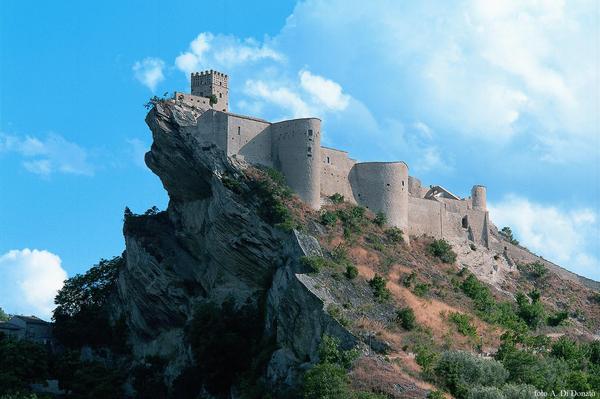
Perched on a giant sandstone boulder, the Roccascalegna Castle is a majestic and striking defensive structure located in the town of Roccascalegna, in the province of Chieti, overlooking the hill between the Sangro and Aventino rivers. The castle was built around the 11th-12th centuries when a simple watchtower of Lombard origin was expanded. Due to the imposing walls and technical and military innovations of the time, the castle was known to the Arabs as “Ruqqah Gawrali.” Around the castle hovers a legend full of charm and mystery, but with somewhat disturbing implications, which has as its protagonists Baron Corvo de Corvis and the edict of “Jus Primae Noctis.” In 1646, the phantom baron forced every new bride in the village to spend her wedding night with him instead of her husband. Legend states that the last new bride, or her husband disguised in turn as a bride, stabbed the baron in the wedding thalamus and he, dying, left his own bloody handprint on a rock in the tower, which later collapsed in 1940.
PENS
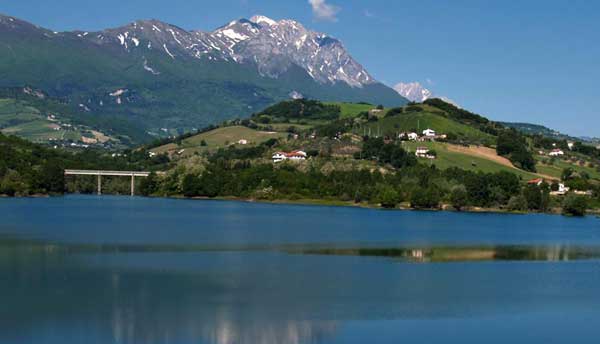
Another magnificent Abruzzo village that is absolutely not to be missed is Penne, one of the most important centers in the province of Pescara and a landmark of the Vestina area. An ancient and magnificent city of art, Penne is also called the “city of bricks” because of the abundant use of bricks both in the buildings and in the paving of the historic center. The city center is characterized by the presence of magnificent monuments and elegant 18th-century buildings, among which the scenic Porta San Francesco, the ancient cathedral of St. Mary of the Angels and St. Maximus Martyr, and the church and former convent of St. Dominic deserve special mention. A few kilometers from the historic center is the “Lago di Penne” Nature Reserve, a magnificent protected area that includes an interesting Nature Museum, Butterfly Garden, Environmental Education Center and a nature trail with huts for bird watching.
ROCCA CALASCIO
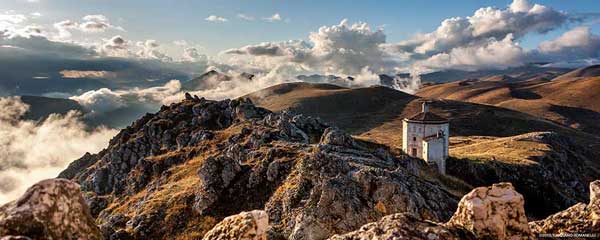
Abruzzo has a vast heritage of castles that grace the valleys and scenic mountains, but Rocca Calascio is as impressive as a castle lover can find. A postcard-perfect, magical place, Rocca Calascio is a medieval fortification positioned at an altitude of 1,464 meters (4,937 feet) in the Gran Sasso and Monti della Laga National Park. The fortress, which was originally built as a watchtower around the 12th century, is made entirely of white stone and can be reached through picturesque, winding lanes that climb the rocks. Well camouflaged with the cliff on which it stands, Rocca Calascio dominates the ancient fortified village and the more recently built town.
SCANNO AND ITS LAKE
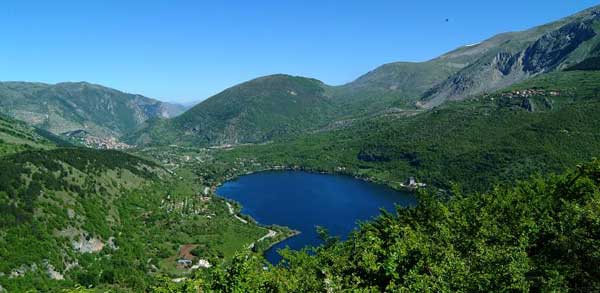
Set in the Upper Sagittario Valley, with wild and almost completely unspoiled nature framing the town, Scanno is an enchanting and romantic village in the province of L’Aquila. The village, among the main itineraries in Abruzzo, is also known as the “City of Photographers” as it has been appreciated by many Italian and foreign photographers, including Hilde Lotz-Bauer, Henri Cartier-Bresson, Mario Giacomelli, Gianni Berengo Gardin and Ferdinando Scianna. Renowned for its filigree and lace-making, Scanno is a true architectural and urban jewel, offering visitors a large number of examples of medieval buildings, from churches to noble palaces. Also well known are the small goldsmith stores, in which one cannot fail to notice the Presentosa, a traditional Abruzzo women’s jewel that has a long history behind it. Of particular beauty is its lake, a real postcard that from some views takes on the shape of a heart.
HERMITAGE OF SAN BARTOLOMEO IN LEGIO
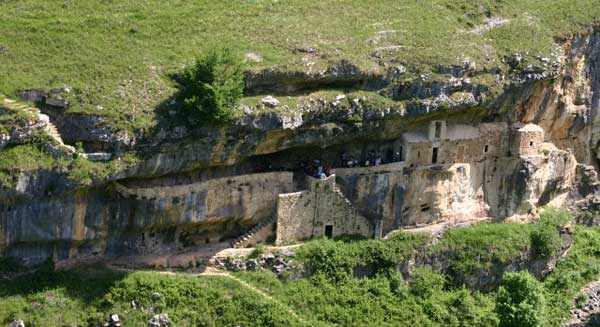
Disarmingly beautiful, the Hermitage of San Bartolomeo in Legio is one of Majella’s most pleasant and famous Celestinian Hermitages. Located halfway up the hillside on the sunny side of the Vallone di S. Spirito, the hermitage is literally carved into a rocky outcrop about 700 m above sea level in the municipality of Roccamorice, in the province of Pescara. The rooms of the hermitage, which is a small convent with an adjoining chapel, are accessed via a staircase carved into the rock, the Scala Santa, which leads to a rocky balcony at the end of which is the church. Every year on August 25 the saint is celebrated and large numbers of pilgrims come to St. Bartholomew’s to participate in the various religious events.
TRABOCCHI COAST
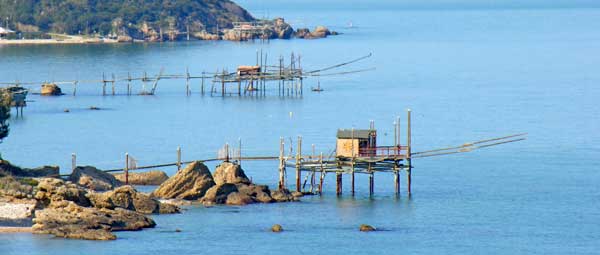
Abruzzo is a seaside region, with kilometers of coastline full of extraordinary landscapes, very different from each other. In particular, the stretch of coastline in the province of Chieti offers striking views, coves, headlands, and high and jagged cliffs, making it unique and comparable to the oceanic coasts of Portugal or Scotland. This stretch of coastline, famous for its natural beauty and heterogeneity, is known as the Trabocchi Coast because of the scenic fishing piles that characterize it, which represent a characteristic architectural element and a symbol of the history and culture not only of this strip of the region, but of the entire Abruzzo region. Rich in important Nature Reserves such as Punta Aderci and Puntapenna, this area alternates wild vegetation with cliffs rich in inlets and small headlands overlooking the sea, enriched by colorful broom, vineyards and olive trees.
FORTRESS OF CIVITELLA DEL TRONTO
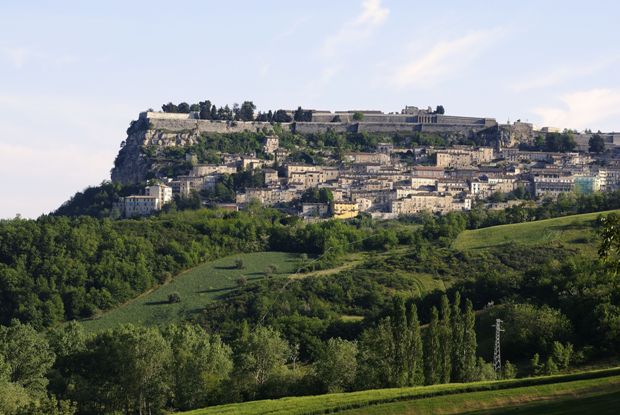
Situated 600 m. above sea level in a strategic position with respect to the former northern border of the Viceroyalty of Naples with the Papal State, the Fortress of Civitella del Tronto is an extraordinary work of military engineering, among the largest and most majestic in Europe, characterized by an elliptical shape with an extension of 25,000 sq. m. and a length of more than 500 m. The Aragonese fortress, comparable to the Hohensalzburg Fortress in Salzburg in terms of its grandeur, was completely transformed starting in 1564 by Philip II of Habsburg, who, following heroic resistance by the people of Civitella, ordered the reconstruction and expansion of the fortress and the village below, which it has always guarded. The visit takes in three covered walkways, the vast parade grounds, the cisterns (one of which can be visited), the long patrol walkways, the remains of the Governor’s Palace, the Church of St. James and the soldiers’ barracks. Particularly impressive is the view from the Fortress. The Weapons Museum, where ancient weapons and maps are kept, can also be visited inside.
Get a quote now, with no obligation!